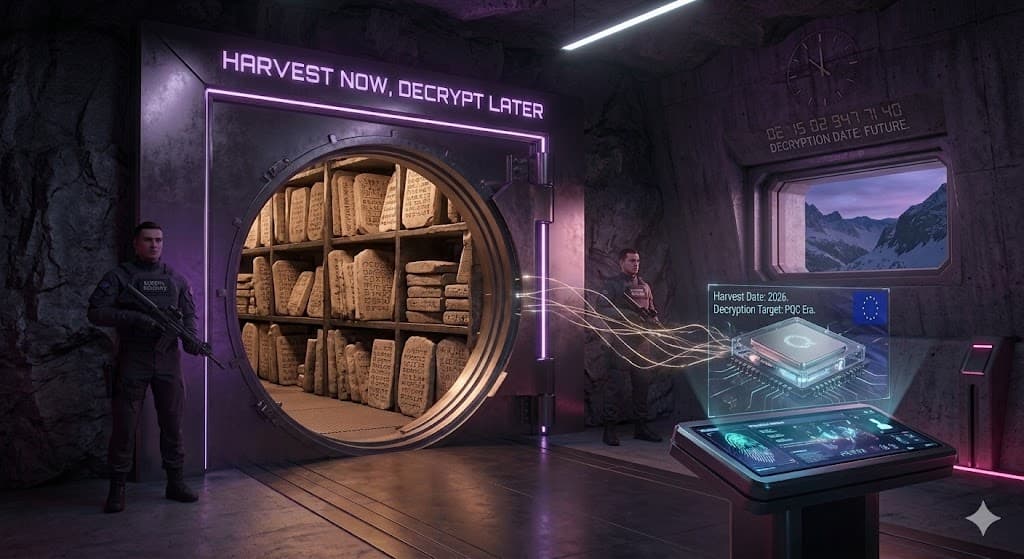
Harvest Now, Decrypt Later: Your Encrypted Data Has an Expiration Date
Imagine someone breaks into your office tonight. But instead of stealing anything, they just photograph every document, every file, every note on your desk. They don't read any of it — they can't, because it's all written in a language they don't understand yet.
But they're patient. And they know that in a few years, they'll learn the language.
That's exactly what's happening right now with your encrypted data. And it has a name: Harvest Now, Decrypt Later.
What does that actually mean?
It's deceptively simple. State actors and sophisticated threat groups are intercepting and storing encrypted communications today — banking transactions, government data, healthcare records, trade secrets — with the intention of decrypting them later, once quantum computers are powerful enough to break current encryption.
This isn't science fiction. Intelligence agencies have been doing this for years. The NSA, China's MSS, and others maintain massive storage facilities for exactly this purpose. The data they're collecting today will still be sensitive in 5, 10, or 20 years.
And here's the uncomfortable part: RSA and ECC — the algorithms protecting most of the internet right now — are mathematically vulnerable to quantum computers. It's not a question of "if." It's "when."
"But quantum computers are years away..."
That's what people said about AI in 2020.
The reality is that nobody knows exactly when a cryptographically relevant quantum computer will exist. Estimates range from 2029 to 2035. But consider this:
- Your customer data from today will still be sensitive in 2035
- Medical records are legally protected for decades
- Trade secrets don't have an expiration date
- Government classified data stays classified for 25 to 50 years
If your data has a shelf life longer than the time until quantum computers arrive, you're already exposed. The clock started ticking a while ago.
The EU knows this
The European Union published its Post-Quantum Cryptography Roadmap in June 2025, setting a clear path for critical infrastructure to migrate to quantum-safe encryption by 2030. NIS2 and DORA regulations already require financial services, energy, and healthcare organisations to address the quantum threat.
This isn't a recommendation. It's regulation. And the deadline is closer than you think.
So what do you actually do about it?
The good news: NIST finalised three post-quantum cryptography standards in 2024 — FIPS 203, 204, and 205. These algorithms (ML-KEM for key exchange, ML-DSA for digital signatures) are designed to resist both classical and quantum attacks.
The migration path is clear:
- Audit what encryption you're using today. Hint: it's probably RSA or ECC everywhere.
- Prioritise data with the longest sensitivity lifetime.
- Start migrating to post-quantum algorithms now, before regulatory deadlines force your hand.
- Don't go it alone — implementing PQC correctly requires cryptographic engineering expertise, not just swapping a library.
This is why we built QuantumAPI
At Kovimatic, we've spent years building a platform that makes post-quantum cryptography accessible. Not as a research project, but as production infrastructure you can integrate today:
QuantumKeys for encryption-as-a-service with ML-KEM and ML-DSA. QuantumVault for quantum-safe secrets management. QuantumID for identity and access management with post-quantum MFA.
All deployed on European infrastructure, under EU jurisdiction.
Because the best time to protect your data from quantum computers was yesterday. The second best time is now.